
China Top 10 Dental Surgery Lighting Manufacturers?
Choosing a dental operating light is not a simple price comparison. Brightness matters, but shadow control, color accuracy, heat, movement, and sterilization requirements matter too. This guide examines China’s leading dental surgery lighting manufacturers through a practical clinical lens. It focuses on products used in dental hospitals, private clinics, teaching facilities, and mobile treatment rooms.
The phrase Dental Surgery Lighting China covers more than factory capacity. It also includes optical engineering, ergonomic design, quality control, and after-sales support. Reliable manufacturers should provide measurable specifications, clear installation guidance, and documentation for electrical and medical-device requirements. Useful details include illuminance at a working distance, color rendering performance, adjustable intensity, sterilizable handles, and arm stability. A good lamp should move smoothly above the patient without drifting during treatment.
The selected companies are assessed using product evidence, industry experience, technical communication, and reported customer service. We also consider certifications carefully, rather than treating a logo as complete proof. Some manufacturers present impressive brochures, yet provide limited clinical data. That weakness deserves attention. Market rankings can also change as factories update models, expand exports, or improve support networks. Therefore, this list should guide further verification, not replace it. Buyers should request samples, test glare in a real operatory, confirm warranty terms, and review maintenance access before signing an order. Small details matter. A loose joint can disrupt treatment. A poorly positioned sensor can frustrate clinicians. The strongest manufacturers understand these daily problems and design around them.
Dental Surgery Lighting: Definition, Purpose, and Core Features
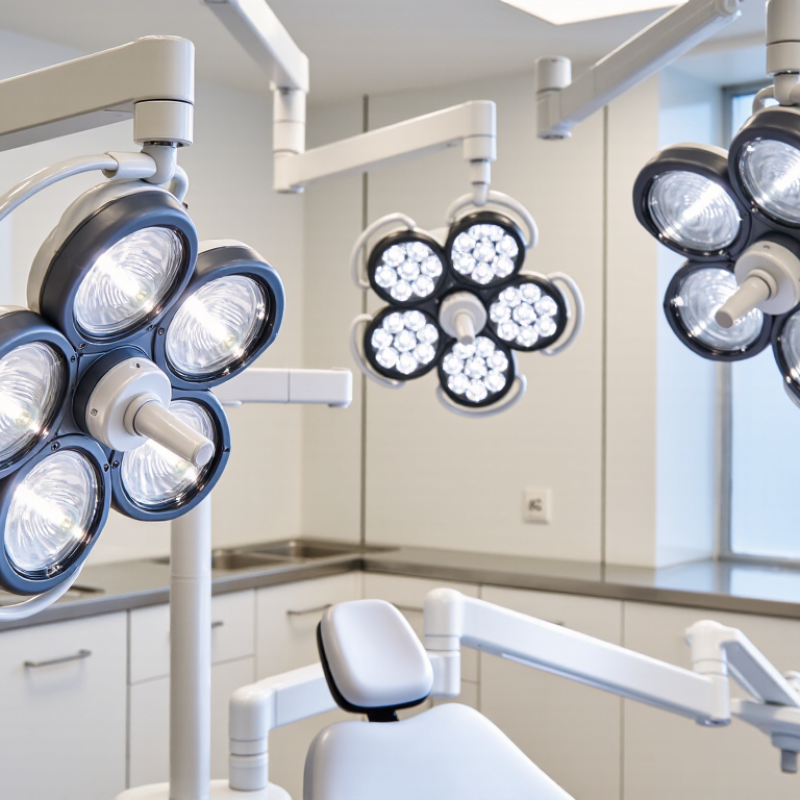
Dental surgery lighting is a clinical illumination system designed for precise work inside the oral cavity. It supports diagnosis, tissue handling, restoration, and surgical procedures. Unlike ordinary ceiling lights, it delivers focused brightness while limiting shadows from the dentist’s head and instruments. Proper lighting reduces visual strain and helps clinicians distinguish enamel, soft tissue, blood, and restorative materials more accurately.
Core features include adjustable intensity, stable color rendering, smooth arm movement, and a wide illumination field. A high color-rendering index helps preserve natural tissue appearance. Touchless controls and sterilizable handles can reduce contamination risks during treatment. Many modern systems also manage heat near the patient’s face.
However, no fixture is perfect. Excessive brightness can cause glare, while poor positioning may still create shadows. Clinical teams should test the light with real instruments, patient chairs, and working angles before selecting equipment.
Documented optical, electrical, and safety testing also improves purchasing confidence when comparing leading manufacturers in China.
Tips: Check illumination at the operating distance, not only in product photos. Move the lamp around a dental chair. Watch for arm drift, delayed controls, and uncomfortable reflections. Ask users about cleaning routines and maintenance access. A small trial can reveal problems that specifications hide. Review the results with dentists, assistants, and infection-control staff. Their practical feedback often matters more than impressive numbers.
How to Evaluate China’s Dental Surgery Lighting Manufacturers
China’s dental lighting market deserves careful technical screening, not a simple top-ten list. The World Health Organization’s Global Oral Health Status Report 2022 estimates that 3.5 billion people live with oral diseases. That demand increases pressure on clinics to choose reliable equipment. During supplier evaluations, request photometric reports, electrical safety documents, and factory quality records. A polished catalogue proves little.
Check illumination against ISO 9680 requirements. Dental operating lights commonly specify 8,000–50,000 lux, with controlled color temperature and high color rendering. Ask whether measurements were taken at the same working distance. Also inspect shadow management, handle sterilization options, fan noise, heat around the patient’s face, and arm stability. Small details matter.
IEC 60601-1 compliance should cover electrical safety, while IEC 60601-2-41 addresses surgical and diagnostic luminaires. Confirm certificates through the issuing laboratory, not only scanned supplier files. The WHO report also highlights unequal access to oral healthcare, making durability and serviceability important in real clinics. Review spare-part availability, repair response times, warranty exclusions, and production traceability. An on-site audit is stronger than a video tour. Yet even audits have limits. A sample may perform better than routine production. Require independent testing, batch records, and a pre-shipment inspection. Grand View Research’s dental equipment market analysis indicates continued global expansion, but growth does not guarantee manufacturing discipline. Evaluate evidence, not promises.
Top 10 Chinese Manufacturers of Dental Surgery Lighting
China’s top ten dental surgery lighting manufacturers are often judged by clinical usefulness, not appearance alone. Their products typically target dental chairs, treatment rooms, and compact surgical spaces. Experienced buyers examine shadow control, color rendering, adjustable intensity, and heat management. A bright lamp can still create glare or eye fatigue.
Reliable manufacturers usually provide photometric reports, electrical safety documentation, and traceable quality procedures. Many use sealed handles, smooth surfaces, and replaceable components for easier cleaning. Look for lighting heads with balanced movement and stable positioning during long procedures. A useful test is simple: move the lamp around a mannequin head and observe shadow changes.
Manufacturing depth also matters. Strong suppliers can manage optical design, metal processing, assembly, calibration, and after-sales support under one system. They should explain LED lifespan, illumination ranges, control methods, and maintenance intervals clearly. ISO-based quality systems may support consistency, but certification alone does not prove clinical performance. Ask for sample testing in a real dental room.
Some comparisons remain imperfect. Product data can use different testing distances, making direct ranking difficult. A lower price may hide weaker joints, noisy controls, or limited spare parts. I would also question unusually high brightness claims without glare measurements. The best choice depends on procedure type, ceiling height, room layout, and local service capability. Supplier communication matters more than polished brochures.
China's Dental Surgery Lighting Market: Common Specification Benchmarks
This chart presents representative central illuminance levels commonly specified for dental examination, treatment, and surgical lighting. The figures are technical market benchmarks rather than rankings or data from individual companies and brands.
Product Types, Technologies, and Clinical Applications
China’s dental surgery lighting manufacturers produce ceiling-mounted, wall-mounted, and mobile examination lights. Each format serves a different clinical workflow. Ceiling systems save floor space and support stable positioning during oral surgery. Mobile units help smaller clinics adjust treatment rooms quickly. Compact lights suit restorative work, endodontics, and pediatric examinations.
Modern models mainly use high-efficiency LED arrays. Multiple light sources can reduce shadows around the clinician’s hands and instruments. Adjustable color temperature improves visual contrast between enamel, soft tissue, and composite materials. High color rendering remains important for shade matching and tissue assessment. Touchless sensors, dimming controls, and autoclavable handles also support cleaner daily operation. Some systems include battery backup for rooms with unstable power.
Clinical application should guide selection, not appearance alone. Implant surgery may require a broad, steady beam and precise positioning. General treatment often benefits from moderate intensity and simple controls. A light that feels bright in a showroom may create glare during a long procedure. This is easy to overlook. In practice, clinicians should test arm movement, shadow behavior, heat, and cleaning access before installation. Technical specifications are useful, but they cannot replace hands-on evaluation. Manufacturing quality also depends on optical calibration, electrical safety testing, documentation, and responsive after-sales support. Some buyers focus heavily on illumination strength and underestimate maintenance. That decision can become costly.
China Top 10 Dental Surgery Lighting Manufacturers? - Product Types, Technologies, and Clinical Applications
Comparative overview of commonly manufactured dental surgery lighting configurations, technologies, specifications, and clinical uses in China.
| No. | Manufacturer Profile | Primary Product Type | Typical Illumination | Core Lighting Technology | Control and Ergonomics | Clinical Applications | Common Compliance Focus |
|---|---|---|---|---|---|---|---|
| 01 | Profile A | Ceiling-mounted dental operating light | 15,000–50,000 lux; adjustable intensity | Multi-LED array with shadow-reduction optics and high color rendering | Sterilizable handles, articulated arms, touch or non-contact controls | General dentistry, restorative treatment, prosthodontics | IEC 60601-1, IEC 60601-1-2, ISO 9680 where applicable |
| 02 | Profile B | Chair-mounted examination light | 8,000–30,000 lux | Compact LED modules with focused beam distribution | Chair-integrated switch, flexible positioning, lightweight head | Routine examinations, hygiene procedures, pediatric dentistry | Electrical safety, electromagnetic compatibility, cleanability |
| 03 | Profile C | Mobile dental surgery light | 20,000–60,000 lux | Battery-supported LED illumination with low-heat operation | Lockable casters, rechargeable battery, height adjustment | Multi-room clinics, temporary rooms, outreach dentistry | Battery safety, mechanical stability, electrical protection |
| 04 | Profile D | Oral surgery operating light | 30,000–80,000 lux | Deep-cavity optical design, uniform beam, reduced shadowing | Long-reach arm, sealed controls, detachable sterilizable handles | Implant surgery, oral surgery, periodontal procedures | Medical-device risk management and illumination performance |
| 05 | Profile E | Endodontic treatment light | 10,000–40,000 lux | High-CRI LEDs, focused beam, optional color-temperature adjustment | Fine-positioning joints and glare-controlled light head | Root-canal treatment, microscopic and minimally invasive procedures | Color rendering, optical uniformity, surface disinfection compatibility |
| 06 | Profile F | High-CRI restorative dentistry light | 15,000–45,000 lux; CRI commonly ≥90 | Balanced spectrum LED technology designed for shade assessment | Intensity presets, color-temperature selection, ergonomic handle | Composite restorations, veneers, crown and bridge procedures | Photobiological safety, color consistency, electrical safety |
| 07 | Profile G | Integrated dental unit light | 12,000–35,000 lux | Energy-efficient LED array with automatic intensity memory | Unit-mounted controls, sensor activation, compact movement range | General practice, dental teaching laboratories, group clinics | Integration with dental unit controls and infection-control requirements |
| 08 | Profile H | Ceiling dual-head surgical lighting system | 40,000–100,000 lux per head | Overlapping LED fields for enhanced cavity visibility and shadow control | Independent head adjustment, sterile handles, large movement envelope | Complex oral and maxillofacial surgery, hospital dental departments | Medical electrical equipment, installation safety, cleaning validation |
| 09 | Profile I | Portable LED examination lamp | 5,000–25,000 lux | Low-power LED source with adjustable beam angle | Compact frame, rechargeable power supply, manual dimming | Mobile clinics, emergency dental care, auxiliary examination | Portable-equipment safety, battery management, enclosure protection |
| 10 | Profile J | Smart sensor-controlled dental light | 15,000–50,000 lux; multiple preset modes | Digital LED control, proximity sensors, automatic intensity adjustment | Hands-free operation, status indicators, programmable settings | Digital dental clinics, infection-sensitive procedures, high-throughput practices | EMC performance, sensor reliability, disinfection and usability testing |
Buying Considerations for Dental Clinics and Distributors
A bright lamp is not automatically a good lamp. Dental clinics should compare illuminance, beam uniformity, color rendering, and shadow control. ISO 9680:2021 provides a useful reference for evaluating dental operating lights. Buyers should request test results, not rely only on catalog descriptions. A high color-rendering score helps clinicians distinguish tissue tones, blood, and restorative materials more accurately. Adjustable color temperature can also reduce visual fatigue during long procedures.
The WHO Global Oral Health Status Report 2022 estimates that oral diseases affect nearly 3.5 billion people worldwide. This demand makes dependable equipment important for both clinics and distributors. Check whether the light head supports smooth positioning with one hand. Confirm that handles can be removed or covered for infection control. Surfaces should tolerate approved disinfectants without cracking or discoloration. Small details matter.
For distributors, spare parts and technical training deserve equal attention. Ask about LED module life, driver replacement, warranty terms, and local service response. A low purchase price may become expensive after repeated downtime. Verify electrical safety documentation and installation requirements before ordering. Poor ceiling reinforcement can create avoidable problems. I would also test the light in a real treatment room, because showroom brightness can be misleading. Some purchasing teams overlook glare on monitors and reflective instruments. That mistake is easy to make.
