What Is Waterproof LED Tape Light and How Does It Work?
Waterproof LED Tape Light brings flexible illumination to places where ordinary LED strips may fail. It can outline a garden path, brighten a shower niche, or trace the edge of a boat deck. However, “waterproof” is not a complete explanation. The strip’s IP rating, sealing material, connectors, and installation method all affect its real performance.
Lighting educator David Warfel offers a useful reminder: “Light is a tool, not a decoration.” That idea applies here. A bright strip is not automatically a suitable strip. Outdoor steps need controlled glare. Damp bathrooms need protected connections. Pools and submerged areas require products specifically approved for those conditions, not simply a silicone-coated reel.
At its core, Waterproof LED Tape Light uses small light-emitting diodes mounted on a flexible circuit board. Electrical current flows through the board and powers each diode. A silicone or polyurethane layer helps block moisture, dust, and accidental splashes. Some models use dense silicone jackets, while others rely on surface coatings. These designs do not behave identically.
Heat still matters. Even a sealed strip can lose brightness when installed on a poor surface. An aluminum channel can help transfer heat away from the LEDs. Correct voltage is equally important. A 12-volt strip connected incorrectly may flicker, overheat, or fail early.
The details are easy to underestimate. I once saw a beautifully sealed strip fail because its cut end remained exposed. Waterproofing is a system, not a label. This guide explains how the technology works, how ratings should be read, and where installation mistakes commonly appear. Some assumptions may need questioning, especially when “waterproof” sounds stronger than the product specifications.
What Is Waterproof LED Tape Light?
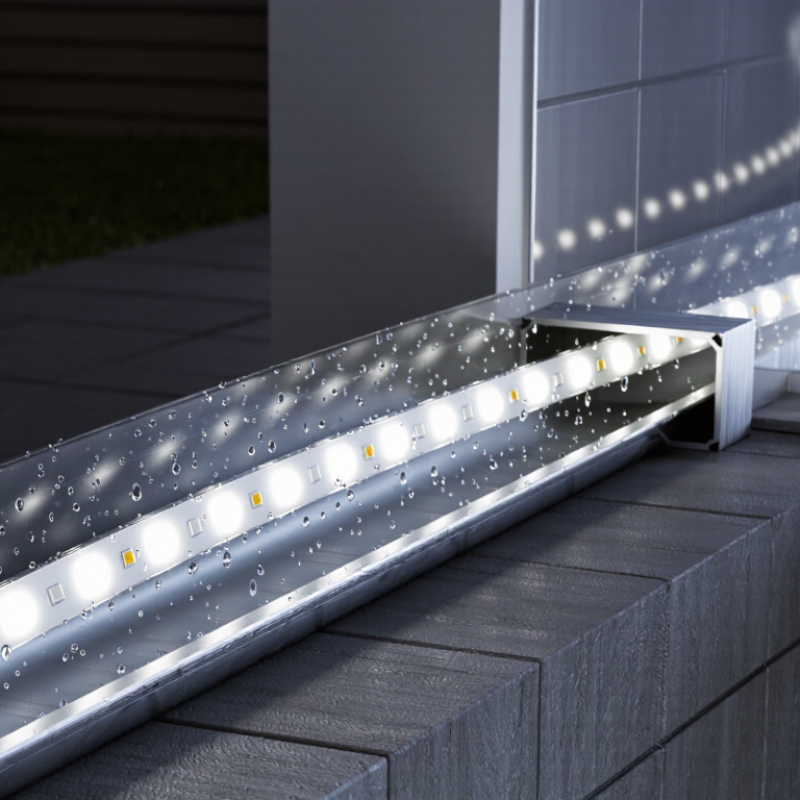
Waterproof LED tape light is a flexible circuit strip designed for damp or wet locations. Small light-emitting diodes sit on a narrow copper-based board, while a silicone coating or sealed housing protects the electrical parts. The protection level is shown by an IP rating under IEC 60529. IP65 resists water jets, while IP67 allows temporary immersion. These ratings are not interchangeable.
The tape works by receiving low-voltage direct current from a suitable power supply. Resistors regulate current through each LED group, producing light with relatively little heat. Many strips can be cut at marked points, then connected with sealed accessories.
Poor connections remain a common weakness. Water may enter through an exposed end, not the coated surface.
Placement still matters. Under a kitchen cabinet, the strip needs an aluminum channel to spread heat and maintain stable brightness. In a garden feature, drainage and sealed connectors deserve equal attention. The U.S. Department of Energy reports that LED products can use at least 75% less energy and last up to 25 times longer than incandescent lighting. However, those figures describe LED lighting generally, not every waterproof strip.
Real performance changes with temperature, power density, coating quality, and installation.
“Waterproof” can sound absolute. It is not. Industry test reports and the product’s verified IP rating should guide the decision, rather than appearance alone.
What Materials Give LED Tape Light Its Water Resistance?
What makes LED tape light water resistant is not the diodes alone. The protection comes from several materials working as a sealed system. Silicone is often the key layer. It can form a flexible, transparent sleeve around the circuit board while resisting splashes, humidity, and temperature changes. Compared with basic plastic, quality silicone usually stays pliable longer. However, “waterproof” is an easy word to misuse. Some products are only splash resistant, not suitable for constant immersion. IP65 may handle dust and water jets. IP67 allows brief immersion.
PVC is another common protective material. It is affordable and easy to extrude, but it can become stiff or cloudy after long exposure to sunlight. That trade-off matters outdoors. The adhesive backing also affects reliability. A strong acrylic adhesive can hold the strip to clean aluminum. Moisture can still enter through dusty edges or poorly sealed ends.
End caps should use compatible sealant, and soldered connections need their own waterproof cover. In practice, I have seen a perfect silicone sleeve fail because one cut end was left open. Small details matter. Heat, movement, and repeated wetting gradually expose weak points. No material solves poor installation. Even careful work deserves a second inspection after heavy rain. That extra check may reveal peeling adhesive or trapped water before corrosion spreads.
How Does Waterproof LED Tape Light Produce and Control Light?
Waterproof LED tape light is a flexible circuit strip sealed against moisture. Its LEDs convert electrical energy into visible light through semiconductor materials. A low-voltage power supply delivers direct current along copper traces. Each LED receives controlled energy through resistors or integrated current regulation.
Light control happens in several ways. A dimmer changes brightness by rapidly switching power on and off, a method called pulse-width modulation. The human eye sees a steady glow, although the LEDs are cycling quickly. Color-changing versions use separate red, green, and blue LED channels. A controller adjusts each channel’s intensity to create different colors. Careful installation matters because long runs can experience voltage drop. The far end may look noticeably dimmer. I have seen this happen when installers focus on sealing connections but ignore electrical distance. Waterproofing alone does not guarantee reliable performance.
Tips: Check the IP rating before installation, and match it with the location’s moisture exposure. Use waterproof connectors, sealed end caps, and a correctly sized power supply. Keep the strip within its recommended cutting marks. Avoid sharp bends, even when the silicone coating feels flexible. Test the full system before permanent mounting. Leave room for heat to escape, because sealed surfaces can retain warmth. Reflective aluminum channels may improve cooling and create a cleaner beam, but they are not always necessary. A small mistake in planning can become an expensive repair.
What Are the Main Waterproof Ratings and Protection Levels?
Waterproof LED tape light uses a flexible circuit board sealed inside silicone or another protective coating. This barrier blocks moisture, dust, and accidental splashes from reaching the electrical parts. The key protection level is shown by the IP rating. IP means Ingress Protection. Two digits explain it. The first digit measures resistance to solids, while the second measures resistance to water. It sounds simple. Yet many installations fail because the rating is misunderstood.
IP20 offers no meaningful water protection and suits dry indoor spaces.
IP44 resists splashes from different directions, making it useful near sheltered cabinets or covered patios.
IP65 protects against dust and low-pressure water jets. It is often suitable for bathrooms, kitchens, and exposed outdoor surfaces.
IP67 adds temporary protection against immersion, usually under specific depth and time limits.
IP68 supports deeper or longer immersion, but the exact conditions depend on the testing standard.
A higher number is not automatically better for every project.
In real installations, connectors and cut ends are usually the weakest points. A sealed strip can still fail when an open copper pad faces rain. Outdoor steps need sealed end caps, protected connections, and drainage around the mounting channel. Never place tape in standing water unless the complete system supports immersion. I have seen installers trust the strip rating while ignoring the power supply. That is an easy mistake. The rating describes tested conditions, not every real-world situation. Temperature, ultraviolet exposure, bending, and aging can reduce protection over time. A waterproof label is useful, but it is not magic.
How Is Waterproof LED Tape Light Installed and Maintained?
Waterproof LED tape light uses surface-mounted LEDs on a flexible circuit, covered by silicone or another protective layer. Its IP rating matters. Under IEC 60529, IP65 resists water jets, while IP67 allows temporary immersion. These ratings do not make every product suitable for pools or permanent underwater use.
Installation starts with a clean, dry, grease-free surface. Measure twice. Cut only at marked points. Apply the tape without sharp bends, then secure exposed ends with compatible end caps and sealant. Connect a correctly sized low-voltage power supply. Leave ventilation around the supply and controller. The U.S. Department of Energy’s 2023 Solid-State Lighting R&D Opportunities report identifies thermal management as an ongoing performance priority. Heat still shortens LED life, even when the strip is waterproof. An aluminum channel can improve heat transfer and create a straighter finish. In practice, installers sometimes focus too much on sealing and forget heat. That mistake is easy to repeat.
Tips: Inspect joints after heavy rain. Look for cloudy covers, loose adhesive, flickering, or corrosion. Turn power off before cleaning or reconnecting. Use a soft, slightly damp cloth, not abrasive chemicals. Check voltage drop on long runs; dimmer sections may need separate feeds. Keep a simple maintenance record with installation dates and replaced parts. Waterproof does not mean maintenance-free. Seal every joint. Leave room for inspection.
What Is Waterproof LED Tape Light and How Does It Work?
Waterproof LED tape light uses surface-mounted LEDs on a flexible circuit board with a protective silicone coating or silicone extrusion. The coating helps protect the LEDs and conductors from moisture, while a constant-voltage power supply provides the electrical energy required for illumination.
Example electrical load: This chart shows a 24 V waterproof LED tape rated at 9.6 W per meter. Power consumption increases proportionally with installed length, while the required current is calculated as power divided by voltage. Actual values vary by LED density, brightness, voltage, and product design.
Installation and maintenance: Measure the required length, cut only at marked cutting points, mount the tape on a clean dry surface, and use sealed connectors or end caps at every exposed connection. Select a power supply with sufficient capacity and keep it accessible for ventilation and servicing. Inspect the silicone covering, connectors, mounting surface, and power supply periodically for damage, loosened sections, overheating, or moisture penetration.